




Finding a convenient place for your bike can be harder than finding time to ride it. Leaning it against a wall may damage the paint, block a walkway, or allow the bike to fall. Leaving it in a garage corner can make it difficult to reach.
The best way to store a bike at home is to match the storage system to your available space, bike weight, tire width, wall construction, and riding routine. A floor stand provides easy access without lifting the bike, while a wall-mounted rack can free valuable floor space.
This guide explains how to choose between floor stands, wall racks, vertical storage, and other space-saving bike storage ideas for apartments, houses, and garages.
What Is the Best Way to Store a Bike at Home?
For most riders, the choice comes down to two practical options: a floor stand for simple, no-lift access or a wall-mounted rack for saving floor space.
A floor stand usually makes more sense for renters, families, daily commuters, and riders with heavier bikes. A wall rack is often better for small rooms, narrow garages, and anyone who wants to keep the floor clear.
Neither option is automatically better. Before choosing a bike storage system, check your available space, mounting surface, bike weight, tire dimensions, and frame shape. The right setup should hold the bike securely without making it difficult to begin your next ride.
- Choose a floor stand if you cannot drill into the wall or do not want to lift the bike.
- Choose a wall rack if floor space is limited and the wall can support the installed system.
- Choose vertical storage if you need to fit several bikes along one wall.
- Choose overhead storage only for bikes that can be raised and lowered safely.
What to Measure Before Choosing Bike Storage
Do not choose a rack based only on a product photo or wheel diameter. Bikes with the same wheel size can have different tire widths, handlebars, frame shapes, and total weights.
Bike length
Measure from the front edge of the front tire to the rear edge of the back tire. This measurement shows how much wall or floor length the bike will occupy.
Handlebar width
Handlebar width often determines how far the bike extends into the room. It is especially important for wall-mounted and vertical storage.
Bike height
Measure from the floor to the highest point of the bike. Depending on the bike, this may be the handlebar, saddle, or another component.
Tire width and wheel diameter
Wheel hooks, channels, and floor supports must fit the actual tire. Check both the wheel diameter and tire width, especially for mountain bikes, gravel bikes, and bikes with wide tires.
Total bike weight
Include attached racks, bags, locks, bottles, and other accessories. If you have an e-bike, compare its complete weight with the storage rack's published load limit.
Loading and removal space
Leave enough room to roll, turn, lift, or pivot the bike into position. Remember to check nearby doors, drawers, shelves, vehicles, and walking paths.
Wall or ceiling construction
A wall-mounted rack must be attached to a suitable structural surface with the correct hardware. Drywall alone should not be treated as equivalent to a wood stud, masonry wall, or another structural support.
Before drilling, use painter's tape to outline the stored bike on the wall and floor. Open nearby doors and cabinets, then walk through the area as you normally would. This quick test can reveal clearance problems before installation.

7 Bike Storage Ideas for Your Home
1. Use a freestanding floor bike stand
A floor stand supports one wheel and keeps the bike upright without permanent wall installation. It is one of the easiest options for apartments, rental homes, and garages where the bike is used frequently.
The main benefit is convenience. You can roll the bike into position instead of lifting it. A freestanding rack can also be moved when your room or garage layout changes.
The tradeoff is that the bike still occupies floor space. Check that the stand is stable and compatible with the bike's tire size. The support should not press against the derailleur, brake rotor, spokes, or another delicate component.
The ROCKBROS Foldable Carbon Steel Bike Stand offers front-wheel, rear-wheel, and vertical parking positions. The product is designed for 700C road bikes and 24- to 27.5-inch mountain bikes. Its foldable carbon-steel design also makes it easier to store or transport when it is not in use. Check your bike's exact wheel and tire fit before choosing it.
Because the product page does not currently publish a verified maximum bike-weight rating, do not assume that this stand is suitable for every e-bike.
2. Mount the bike horizontally on a wall
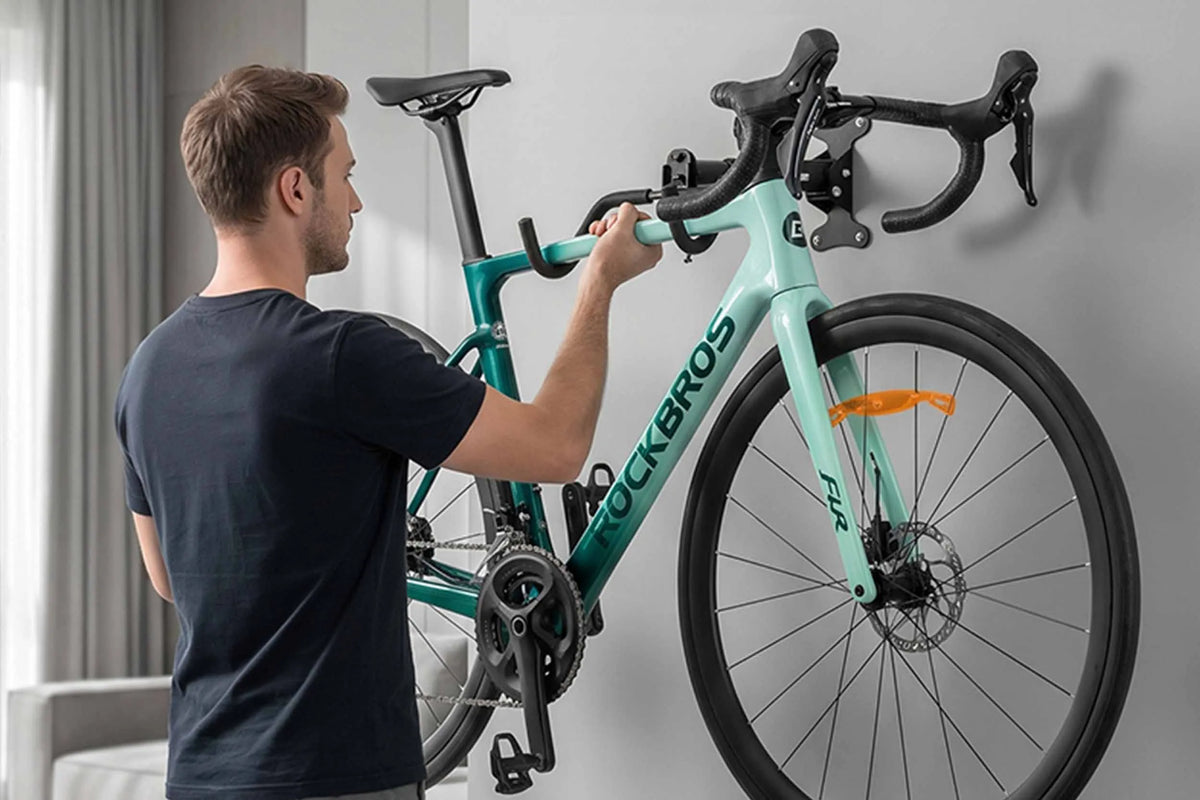
A horizontal wall rack holds the bike parallel to the wall, often by supporting the frame. It can free floor space and turn the bike into an organized part of the room.
This option works well for one bike on an open wall. However, the handlebars and pedals will still extend into the room. Measure their full projection before deciding where to install the rack.
Frame shape also matters. Step-through frames, compact frames, and unusually shaped tubes may not rest evenly on every horizontal rack. Check how the contact points support your particular bike.
The ROCKBROS Retractable Wall-Mounted Bike Rack uses a carbon-steel structure with TPE-coated contact areas. Its adjustable support arms help accommodate different frame shapes, and the rack can fold toward the wall when it is not holding a bike.
This wall rack has a published load limit of 15 kg, or 33 lb. Do not use it for a bike that exceeds that limit, and make sure it is installed into a suitable mounting surface according to the product instructions.
3. Hang the bike vertically
Vertical storage positions the bike upright against the wall, usually with one wheel held by a hook or channel. It uses less wall width than horizontal storage, making it useful for storing several bikes next to one another.
The bike will still extend into the room by approximately its handlebar width. You also need enough ceiling height and enough strength to raise one end of the bike.
When storing multiple bikes, alternate their height or direction so the handlebars and pedals do not collide. Confirm that each hook fits the tire and rim before use.
4. Choose a folding wall rack
A folding wall rack can be moved closer to the wall when no bike is stored. This feature is useful in multipurpose rooms, laundry areas, and garages where the space needs to remain flexible.
Folding the rack does not reduce the bike's dimensions while it is loaded. Measure the handlebar width and the complete loaded projection. Position the rack where its folding mechanism will not hit furniture, doors, or nearby storage.
5. Create a multi-bike storage zone
For a household with several bikes, accessibility matters as much as capacity. A tightly packed system may save space, but it becomes frustrating if three bikes must be moved to reach the one used most often.
Keep daily commuter bikes and children's bikes near the front or at floor level. Place occasional-use bikes farther back or higher on the wall. Stagger handlebars and pedals, and leave a clear route for removing each bike.
A combination of storage types often works better than one large rack. For example, a heavy bike can remain in a floor stand while lighter road bikes are stored vertically.
6. Use ceiling storage for seasonal bikes
Ceiling hoists and overhead racks can recover both wall and floor space. They are generally more practical for lighter bikes that are not used every day.
Confirm the ceiling structure, hardware capacity, lifting method, and clearance above people and vehicles. Secure loose straps and make sure the bike cannot swing. If lifting the bike overhead feels difficult or unstable, choose a lower storage method.
7. Set up a protected garage or covered storage area
A garage usually provides more room, but it can expose a bike to moisture, dust, temperature changes, tools, chemicals, and vehicle traffic.
Choose a dry location away from anything that could fall onto the bike. If a shed or covered outdoor area is your only option, keep the bike off wet ground and protect it from rain and direct sunlight. Use a breathable cover so moisture is not trapped against the frame and components.
A storage rack keeps a bike organized, but it does not provide theft protection. If other people can access the storage area, secure the bike to a suitable anchor with an appropriate bike lock.
Floor Bike Stand vs. Wall-Mounted Bike Rack
| Factor | Floor Bike Stand | Wall-Mounted Bike Rack |
|---|---|---|
| Installation | Usually requires little or no installation | Requires secure wall mounting |
| Floor space | The bike remains on the floor | Frees the area below the bike |
| Lifting | Usually little or no lifting | Often requires lifting the bike |
| Rental-friendly | Usually suitable for rentals | Depends on lease and wall-repair rules |
| Daily access | Fast and convenient | Depends on installation height |
| Heavy bikes | Often easier to load, but capacity must still be checked | Suitable only when the bike is within the rack's rated capacity |
| Relocation | Usually easy to move | Remains fixed after installation |
| Best for | Renters, families, frequent riders, and no-lift storage | Small rooms, organized garages, and clear floor space |
Use this comparison as a starting point rather than an absolute rule. The individual rack design, bike weight, mounting height, and available clearance are more important than the category name alone.

Best Bike Storage for an Apartment
Apartment bike storage usually involves three limitations: drilling restrictions, limited clearance, and the need to keep shared or private exit routes open.
If drilling is not allowed, start with a freestanding floor stand. Do not assume that an adhesive hook can hold a bicycle. Its performance depends on the stated load capacity, wall surface, installation quality, and surrounding conditions.
Use these steps to protect both the apartment and the bike:
- Place a washable mat beneath wet or dirty tires.
- Wipe road grit from the bike before bringing it inside.
- Add a wall guard where a tire may touch painted surfaces.
- Rotate the inside pedal upward to reduce how far it extends into the room.
- Keep the bike away from heaters and prolonged direct sunlight.
- Make sure doors, hallways, windows, and stairs remain accessible.
E-bikes and their batteries should never block a doorway, hallway, stairway, window, or another exit route. For additional guidance, review the FDNY lithium-ion battery safety recommendations .
Best Bike Storage for a Garage
Begin by mapping how people, bikes, and vehicles move through the garage. Check the swing of each door, the space around parked cars, and the route used to roll a bike outside.
Floor stands placed near the garage door are convenient for frequently used bikes. Staggered vertical racks can use wall space efficiently when several lighter bikes need to be stored. Seasonal bikes can be positioned higher only when the mounting structure and lifting process are safe.
Keep helmets, pumps, and locks close to the bikes, but do not hang heavy accessories from a rack unless it includes a suitable accessory point. Store chemicals, sharp tools, and unstable boxes separately.
Allow a wet bike to dry before long-term storage. Check the garage for roof leaks, plumbing leaks, condensation, and areas where water collects on the floor.
How to Store an E-Bike Safely at Home
E-bikes require additional planning because they are usually heavier than standard bicycles and contain a lithium-ion battery.
Check the complete bike weight
Weigh the bike with the accessories that will remain attached during storage. Compare that number with the rack's published capacity. Do not estimate compatibility from a product photo.
Even when a wall rack is technically rated for the bike, consider whether you can lift and lower it under control. A floor-level storage option is often more practical for a heavy e-bike.
Follow the bike manufacturer's battery instructions
Battery removal and long-term charge recommendations vary by model. Follow the instructions supplied by the e-bike or battery manufacturer instead of applying one rule to every e-bike.
Create a safer charging area
Use the charger supplied or approved by the manufacturer. Charge the battery in a dry, well-ventilated area on a stable surface, away from exits and combustible clutter. Position charging cables where they will not create a trip hazard.
Do not charge or use a battery that is swollen, leaking, unusually hot, damaged, modified, or producing an unusual odor or sound. More information is available from the U.S. Consumer Product Safety Commission Micromobility Information Center .
Common Bike Storage Mistakes
Buying a rack before measuring the bike
Wheel diameter alone does not confirm compatibility. Tire width, frame shape, handlebars, fenders, accessories, and total weight can all affect fit.
Mounting a rack into an unsuitable surface
A wall rack is only as secure as its attachment. Use the specified hardware and suitable structural support. Check for concealed wiring or plumbing before drilling.
Ignoring the rack's weight limit
Accessories add weight, and e-bikes can be considerably heavier than standard bikes. Always remain within the product's published load limit.
Forgetting handlebar and pedal clearance
The frame may fit against a wall while the handlebar blocks a doorway or the pedal hits a cabinet. Test the complete outline of the stored bike.
Packing several bikes too closely
A storage system becomes inconvenient if every bike must be moved to reach one frequently used bike. Plan for independent access whenever possible.
Storing a wet or dirty bike
Dry the bike and remove road salt, mud, and grit before extended storage. This helps protect the bike, floor, and surrounding walls.
Positioning a heavy bike too high
High storage only saves useful space when the bike can be loaded and removed safely. Keep heavy bikes at floor level when lifting is difficult.
Blocking an exit route
Never store or charge a bike where it obstructs a doorway, hallway, stairway, window, or another route that may be needed during an emergency.

Bike Storage Checklist
- I measured the bike's length, height, handlebar width, tire width, and total weight.
- The storage system fits the wheel, tire, and frame shape.
- The bike is within the rack's published load limit.
- The floor, wall, or ceiling can support the system as instructed.
- There is enough room to load and remove the bike safely.
- Doors, drawers, vehicles, and walking paths can still be used normally.
- The stored bike does not block an exit route.
- The contact points will not damage the frame, rim, spokes, rotor, or wall.
- Wet tires and dirt will not damage the floor.
- E-bike charging and battery storage follow the manufacturer's instructions.
Frequently Asked Questions
Is it better to store a bike on the floor or on a wall?
A floor stand is generally better for easy access, heavier bikes, and homes where drilling is not allowed. A wall rack is usually better when floor space is limited and the wall can safely support the bike. Choose according to your available space, bike weight, mounting surface, and ability to lift the bike.
Can I hang a bike by its wheel?
Many bikes can be stored with a compatible wheel hook, but the hook must fit the tire and rim. Check the rack and bike manufacturer's instructions, especially for carbon rims, deep-section rims, fenders, and unusual wheel systems.
How can I store a bike in an apartment without drilling?
Use a freestanding floor stand or another no-drill system that is suitable for the bike. Position it outside normal walkways and exit routes, protect the floor from wet tires, and make sure the bike will not tip if it is bumped.
What is the most space-saving way to store a bike?
Vertical wall storage normally uses less wall width, while horizontal wall racks can free the floor and keep the bike at a more accessible height. Ceiling storage recovers the most floor and wall space, but it is less convenient for frequent use and requires safe overhead lifting.
Can I use a regular wall rack for an e-bike?
Only use a wall rack when the complete e-bike is within its published weight limit, the mounting surface is suitable, and you can lift the bike safely. Never assume e-bike compatibility from a product image. A floor-level stand is often the more practical option.
How do I keep a stored bike from damaging the wall or floor?
Clean and dry the bike, place a washable mat beneath it, and add a wall guard where the tires may touch. Use padded rack contact points and make sure the bike cannot swing into the wall.
Should I lower the tire pressure for long-term bike storage?
Follow the tire and bike manufacturer's storage recommendations. Check tire pressure periodically and avoid leaving the bike resting on completely flat tires. Inspect the tires and inflate them to the recommended riding pressure before the next ride.
Build a Storage Setup You Will Actually Use
Good bike storage should make the next ride easier. Begin with accurate measurements, eliminate any system that does not fit your bike or mounting surface, and choose the simplest option that works with your routine.
For a rental home or frequently used bike, that may be a floor stand near the door. For a small room with a suitable wall, a folding wall rack may provide a better use of space. In a family garage, a mixed system can keep heavy and daily-use bikes low while lighter, occasional-use bikes are stored higher.
The goal is not to fit the bike into the smallest possible gap. The goal is to keep it stable, protect the surrounding space, and make it easy to reach whenever you are ready to ride.





Leave a comment
This site is protected by hCaptcha and the hCaptcha Privacy Policy and Terms of Service apply.