


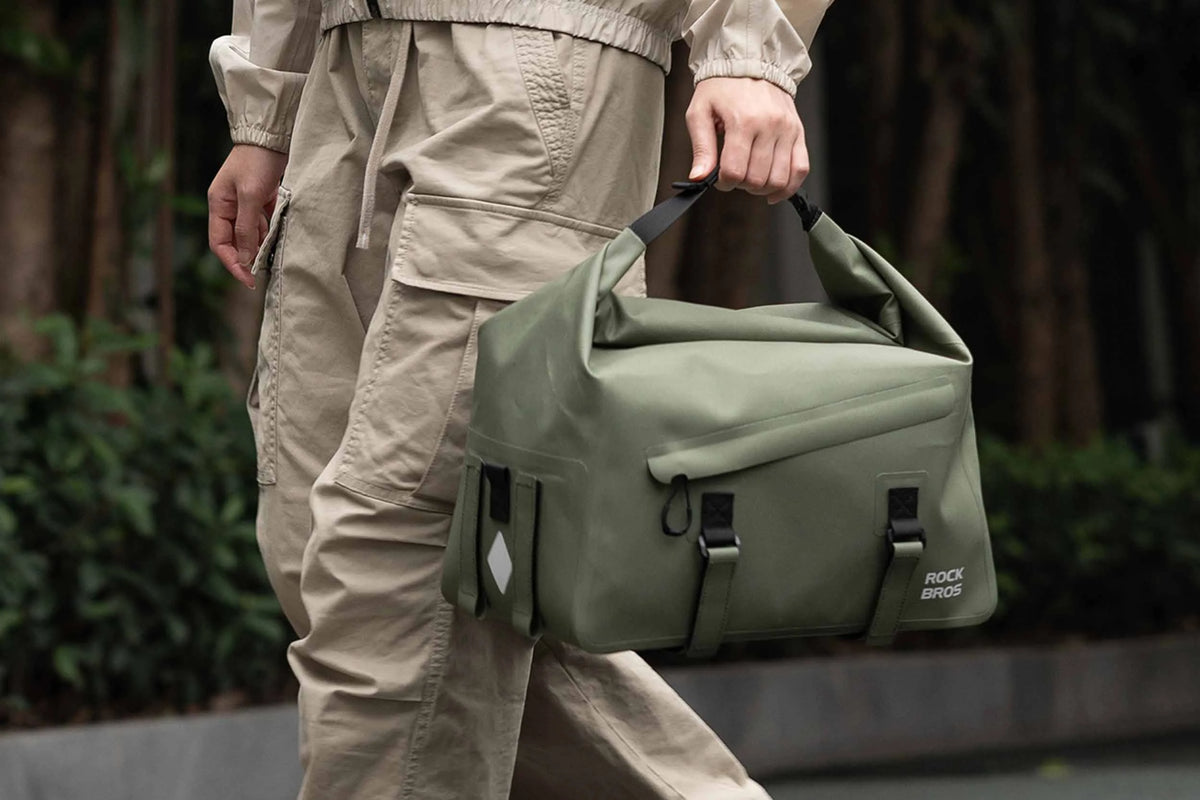
A bike rack bag and a pannier can both move weight off your back, but they handle daily cargo differently. A rack bag sits on top of the rear rack and works well for compact, frequently used items. A pannier hangs beside the rack, giving you more room for groceries, work clothes, and other larger loads.
For most light daily commutes, a rear rack bag offers a simple and balanced setup. For heavier loads or longer rides, panniers usually provide more usable storage. The best choice depends on what you carry, how often you remove the bag, and whether your rear rack fits the mounting system.
Contents
- Bike Rack Bag vs. Panniers: Quick Comparison
- What Is a Bike Rack Bag?
- What Are Bike Panniers?
- Which Option Holds More?
- Which Is Easier for Daily Commuting?
- How Do They Affect the Ride?
- Which Is Better for Riding in the Rain?
- Rear Rack Compatibility and Installation
- Which Bag Fits Your Riding Routine?
- ROCKBROS Bike Bag Options
- Common Mistakes to Avoid
- Final Verdict
Bike Rack Bag vs. Panniers: Quick Comparison
| Feature | Bike Rack Bag | Bike Pannier |
|---|---|---|
| Mounting position | On top of the rear rack | Along one or both sides of the rack |
| Typical use | Daily essentials and lighter commuting loads | Work gear, groceries, touring equipment, and larger loads |
| Access while stopped | Usually easy to open from above | Depends on the closure and mounting position |
| Bike width | Keeps cargo within the general width of the rack | Adds width to one or both sides of the bike |
| Off-bike carrying | Some models include a shoulder strap | Some models include a shoulder strap or backpack conversion |
| Best for | Compact, organized everyday carry | Higher-volume or irregularly shaped cargo |
Quick answer: Choose a rack bag if you carry a lunch, jacket, tools, and small personal items. Choose a pannier if you regularly carry groceries, work clothes, larger equipment, or more cargo than can fit comfortably on top of the rack.
What Is a Bike Rack Bag?
A bike rack bag, sometimes called a trunk bag, attaches to the top platform of a rear bicycle rack. Most models use hook-and-loop straps, buckles, or another removable mounting system.
Because the bag sits directly behind the saddle, it does not add as much side width as a pannier. This can make a rack bag convenient when moving through narrow storage areas, parking beside other bikes, or walking the bike through a doorway.
Advantages of a bike rack bag
- Keeps daily essentials together in one top compartment
- Usually provides convenient access when the bike is parked
- Does not require the rider to carry weight on the shoulders
- Can be easier to handle than a larger pannier for short commutes
- Some models can be removed and carried with a shoulder strap
Possible limitations
A rack bag is limited by the size and shape of the rack platform. Tall or bulky cargo may be difficult to pack, and the bag may occupy the space where you would otherwise strap a jacket, package, or other item.
The bag also needs a secure connection at several points. A poorly tightened rack bag may move when the bike travels over rough pavement.
What Are Bike Panniers?
Bike panniers attach to the side of a rear rack. Riders can use a single pannier for commuting or a matched pair when they need more space and more even left-to-right weight distribution.
The vertical shape of a pannier is useful for clothing, groceries, shoes, and work supplies. Roll-top designs can also make it easier to adjust the closure around changing loads.
Advantages of panniers
- Offer space for larger or taller items
- Leave the top of the rack available on many setups
- Can be used individually or as a pair
- Keep cargo weight lower than a top-mounted rack bag
- Work well for commuting, errands, touring, and shopping
Possible limitations
A pannier makes the bicycle wider. Riders should remember this when passing posts, entering narrow spaces, or parking near other bikes.
A heavily loaded single pannier also places more weight on one side. This does not automatically make the bike unsafe, but the uneven load may be noticeable when starting, stopping, pushing, or lifting the bicycle.
Which Option Holds More?
Panniers generally offer more flexible cargo space, especially when two bags are used. However, bag style matters more than the category name alone. A large rack bag can hold more than a compact pannier, so compare the stated capacity and usable compartment shape of the specific models.
A rack bag is usually sufficient for items such as:
- A compact lunch container
- A lightweight jacket
- A small repair kit and bike lock
- A water bottle
- Keys, wallet, phone, and personal accessories
A pannier is often more practical for:
- A change of clothes and shoes
- Groceries or takeaway containers
- Bulkier work equipment
- Cold-weather layers
- Gear for longer recreational rides
Do not select capacity based only on a liter rating. Check the bag’s dimensions, closure, internal shape, and opening. A narrow bag may have enough total volume but still be unsuitable for a wide lunch box or rigid item.

Which Is Easier for Daily Commuting?
A rack bag is often the easier choice for a short commute with a consistent load. You can pack the same group of essentials each day, secure the bag on top of the rack, and remove it when you arrive.
A pannier becomes more convenient when your cargo changes from one trip to the next. Its deeper compartment can accommodate a wider range of items, while a roll-top closure can adapt to different loads.
Think beyond the ride
Your commute does not necessarily end when you park the bike. Consider how far you need to carry the bag through an office, store, train station, or apartment building.
A detachable shoulder strap can be useful for short walking transitions. If you regularly walk farther after parking, a pannier that converts into a backpack may be more comfortable.
Consider how often you need access
If you frequently reach for a phone, gloves, snack, or bike tool, a top-opening rack bag can provide convenient access while stopped. Panniers are better suited to larger items, but smaller belongings may settle at the bottom unless the bag includes separate pockets or you use internal organizers.
How Do They Affect the Ride?
Bag position changes how cargo feels on the bicycle. A rack bag places the load above the rear wheel. A pannier positions much of the load lower and beside the wheel.
A lower load can feel more stable when carrying heavier gear, but a single pannier may create a left-to-right imbalance. A top-mounted rack bag keeps the load centered, although heavy cargo positioned high on the rack can still affect handling.
Whichever style you choose, place heavier items near the bottom of the bag and as close to the bike as possible. Tighten all mounting points, and test the loaded bike at low speed before entering traffic.
Also respect the load limit of your rear rack. The capacity of a bag does not increase the amount of weight the rack or bicycle can safely carry.
Which Is Better for Riding in the Rain?
Neither rack bags nor panniers are automatically waterproof. Weather protection depends on the specific material, seams, closure, zipper design, and construction of the bag.
When comparing products, look for clear descriptions of:
- Water-resistant or waterproof construction
- Welded or sealed seams
- Roll-top closures
- Covered openings
- Included rain covers
“Water-resistant” and “waterproof” should not be treated as the same claim. A water-resistant bag may handle splashes or light rain, while a waterproof design is intended to provide stronger protection against water entry.
Even with a waterproof bag, close the opening correctly and keep moisture-sensitive items in an additional protective sleeve when the consequences of water damage are serious.
Rear Rack Compatibility and Installation
Both bag styles require a compatible rear rack. Before buying a bag, inspect the rack instead of assuming that every mounting system will fit every bicycle.
Check these five points
- Rack dimensions: Compare the platform width, length, tube diameter, and mounting space with the bag.
- Mounting points: Confirm that straps, hooks, or clips can reach secure sections of the rack.
- Heel clearance: A pannier must sit far enough back that your heel does not strike it while pedaling.
- Wheel clearance: The bag, straps, and loose fabric must stay away from the tire and spokes.
- Rack load limit: Include the weight of the bag itself when calculating the total load.
E-bike owners should also check whether the battery, rear light, handle, or wide rack tubing interferes with the bag’s mounting system. A bag described as compatible with many e-bikes may still require enough open rack space for its specific straps or hooks.
Which Bag Fits Your Riding Routine?
For a light daily commute
Choose a rack bag if you normally carry a lunch, jacket, compact tools, and a few personal items. It provides an uncomplicated way to move weight off your back without adding much side width.
For groceries and errands
Choose a pannier if you need to carry taller packages or changing loads. A single large pannier may be sufficient for smaller errands, while two panniers give you more room and can help distribute a heavier load between both sides.
For carrying a laptop
Either style can work, but fit matters. Measure the laptop inside its protective sleeve and compare those measurements with the bag’s internal dimensions. Do not assume that a particular liter rating guarantees laptop compatibility.
Place the computer in a padded sleeve, keep it away from tools or sharp objects, and avoid leaving it loose inside an oversized compartment.
For mixed cycling and walking
Look beyond on-bike storage. A shoulder strap works well for short walks, while a convertible backpack is more practical if you need to continue through a station, campus, office complex, or shopping area.
For touring and longer rides
Panniers are generally more adaptable for longer rides because they can carry more clothing, food, and equipment. A rack bag can still complement panniers by keeping frequently used items accessible on top of the rack.
ROCKBROS Bike Bag Options for Different Commuters
ROCKBROS offers both bike rack bags and bike panniers. The following examples show how different designs match different commuting routines.
For compact daily carry: RideMate Bike Rear Rack Bag
The ROCKBROS RideMate Bike Rear Rack Bag provides approximately 16 liters of expanded storage. Its 600D polyester fabric has a TPU coating, and the bag uses heat-welded construction and a roll-top closure.
A six-point hook-and-loop mounting system secures it to a compatible rear rack. The semi-structured design includes a reinforced bottom, while the detachable shoulder strap supports short off-bike transitions.
This option makes sense for commuters who want to carry daily essentials without wearing a backpack and prefer a bag positioned on top of the rear rack.
For larger or changing loads: AS-166 Bike Pannier
The ROCKBROS AS-166 Fully Waterproof Bike Pannier offers 20 liters of storage with a roll-top design. It uses adjustable mounting hooks, a 360-degree rotating lower mount, and a quick-release system.
The included shoulder strap makes it possible to carry the pannier after removing it from the rack. Reflective detailing is also incorporated into the design.
This pannier is better suited to riders who need additional space for clothes, groceries, tools, or equipment and prefer a side-mounted bag.
For riding and walking: 2-in-1 Rack Bag Backpack
The ROCKBROS 2-in-1 Bicycle Rear Rack Bag Backpack converts from a side-mounted bike bag into a backpack. Its roll-top storage adjusts from 13.5 to 18 liters, and it includes a helmet attachment.
The adjustable hook system is listed for standard rear racks with mounting spacing between 10 and 20 centimeters. Riders should measure their rack before choosing this model.
This design is useful when a commute combines cycling with longer periods of walking, public transportation, or time away from the bike.

Common Mistakes to Avoid
Choosing by capacity alone
Capacity does not explain the shape of the compartment, the size of the opening, or how the bag fits the rack. Compare measurements and imagine where each item will go.
Ignoring heel clearance
A pannier mounted too far forward may contact your heel while pedaling. Check the position with your usual shoes and pedal stroke before riding normally.
Overloading one side
If you use one pannier, pack thoughtfully and test how the bike feels. For heavier cargo, dividing the load between two panniers may produce a more balanced setup.
Leaving straps unsecured
Loose straps can move toward the wheel or spokes. Fasten excess strap length and inspect every mounting point before each ride.
Assuming every bag is waterproof
Read the product description carefully. If the manufacturer describes a bag as water-resistant, do not expect the same protection as a waterproof bag with sealed construction.
Forgetting off-bike use
A bag can work well on the bicycle and still be inconvenient inside a building. Think about carrying comfort, removal time, and whether you need a shoulder strap or backpack conversion.
Final Verdict: Rack Bag or Panniers?
A bike rack bag is usually the better choice for light daily commuting, quick access, and a compact setup. It keeps your essentials centered over the rear wheel and can help you commute without carrying a backpack.
A pannier is usually better when you need more flexible storage for groceries, clothing, work gear, or longer rides. It can carry larger items and keeps much of the load lower, but you need to consider heel clearance, added bike width, and left-to-right weight distribution.
If your routine includes substantial walking after the ride, a convertible pannier backpack may offer the most practical middle ground.
ROCKBROS develops cycling bags for commuting, errands, touring, and everyday riding. Instead of choosing only by appearance or capacity, start with your actual cargo, measure your rear rack, and select the mounting and carrying style that will be easiest to use every day.


Leave a comment
This site is protected by hCaptcha and the hCaptcha Privacy Policy and Terms of Service apply.