


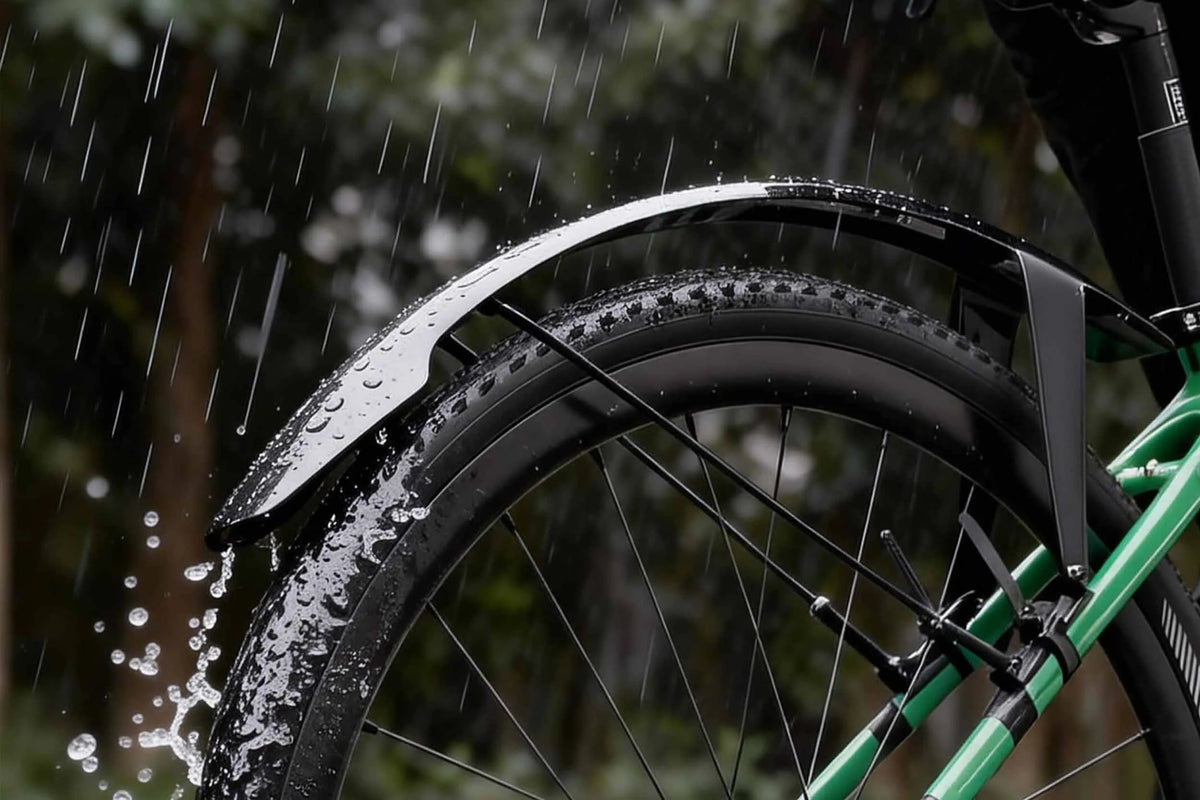
Bike fenders can make wet roads, muddy trails, and daily commutes much easier to manage. They reduce the spray thrown up by your tires, helping keep water and dirt off your clothing, bike, and anyone riding behind you.
However, not every rider needs the same amount of coverage. A year-round commuter may benefit from front and rear fenders, while a mountain biker or occasional wet-weather rider may prefer a smaller, removable design. The best choice depends on your bike, tire size, mounting points, riding conditions, and how easily you want to remove the fenders.
What Do Bike Fenders Do?
Bike fenders, also called mudguards, sit above or behind the tires to intercept water, mud, grit, and other material thrown upward as the wheels rotate.
A rear fender mainly helps prevent the familiar stripe of water and dirt across your back. A front fender can reduce spray toward your feet, lower legs, frame, and drivetrain. Longer fenders generally intercept more spray than short designs, but they also require more installation space.
Fenders cannot keep a rider completely dry during heavy rain. Water can still reach you from above, from the sides, and from passing traffic. Their main purpose is to reduce tire spray, especially when the road remains wet after the rain has stopped.
Do You Need Bike Fenders?
You probably need bike fenders if you regularly commute, ride on wet pavement, travel over muddy trails, or want to arrive with cleaner clothing. They are less important for riders who only go out in dry conditions and do not mind cleaning their bike after occasional wet rides.
| Riding situation | Are fenders useful? | Suggested approach |
|---|---|---|
| Daily commuting | Usually very useful | Consider front and rear coverage |
| Occasional wet roads | Useful when needed | Consider removable or quick-release fenders |
| Muddy mountain bike trails | Useful for reducing direct spray | Choose wider MTB-specific designs |
| Road cycling in mostly dry weather | Optional | A lightweight removable design may be enough |
| Touring and long-distance riding | Often useful | Prioritize stable mounting and broader coverage |
| Indoor riding | Not needed | No fenders required |
Your local conditions matter more than the season alone. November may bring frequent wet roads in some parts of the United States while remaining relatively dry in others. Choose based on the roads and trails you actually ride.
Types of Bike Fenders
Full-Coverage Fenders
Full-coverage fenders follow a larger portion of the wheel. They generally provide the most protection for commuters, touring cyclists, and riders who frequently travel on wet roads.
These fenders often use mounting points near the fork, frame, brake bridge, or dropouts. They can provide a stable fit when properly installed, but not every bicycle has the required mounting points or enough space around the tires.
Quick-Release and Clip-On Fenders
Quick-release fenders attach using clamps, straps, brackets, or removable mounting hardware. They are useful for riders who only need fenders during wet conditions or whose bicycles do not have traditional fender eyelets.
They are normally easier to install and remove, although shorter designs may offer less coverage than full-length fenders. The attachment points should be checked periodically because a loose fender can move toward the tire.
Seatpost-Mounted Rear Fenders
A seatpost-mounted fender is positioned above the rear tire and mainly protects the rider’s back. It is convenient for bikes without rear fender mounts, but it does not provide the same protection for the lower frame, feet, or drivetrain as a longer rear fender.
Before purchasing one, measure the seatpost and check whether bags, lights, racks, or other accessories already occupy the mounting area.
Mountain Bike Fenders
Mountain bike fenders are usually wider and shorter than traditional commuter fenders. Their shape is designed around wide tires, suspension forks, uneven terrain, and the need for greater tire clearance.
A front MTB fender can help reduce mud reaching the rider’s face and fork area. A rear model can reduce spray toward the rider’s back. Because mountain bikes vary greatly, especially between hardtail and full-suspension designs, compatibility should always be checked for the individual bike.
Minimal Saddle Fenders
Small fenders that attach beneath the saddle are light and easy to carry. They may reduce some rear-wheel spray, but their short coverage means they are best treated as a compact backup rather than a replacement for full front and rear protection.

How to Choose Bike Fenders
1. Read the Tire Size
Start by checking the numbers printed on the tire sidewall. A marking such as 700 x 32c describes a 700c wheel with a nominal tire width of 32 millimeters. Mountain bike tires may use markings such as 27.5 x 2.25 or 29 x 2.35.
The fender must support both the wheel diameter and the tire width. Do not assume that every product labeled “universal” will fit every bicycle.
2. Check Fender Width
A fender should be wide enough to cover the tire rather than sitting inside the tire’s outer edges. The exact required width depends on the product design and the space available on the bike.
Follow the compatibility information provided for the exact fender model. If the product page does not clearly support your tire width, confirm the fit before ordering.
3. Measure Tire and Frame Clearance
Check the space between the tire and the fork crown, seatstays, chainstays, brake calipers, and frame bridges. A bicycle may have mounting eyelets but still lack enough room for a full fender.
Remember that the actual tire can be wider than its printed size depending on the rim and inflation pressure. Measure the tire as installed rather than relying entirely on its label.
4. Identify the Available Mounting Points
Look for threaded eyelets near the wheel dropouts and attachment points around the fork crown or frame bridges. These points may support a traditional bolt-on fender.
If your bike does not have them, look for a compatible quick-release, strap-mounted, fork-mounted, or seatpost-mounted option. Do not drill or modify a frame unless the bicycle manufacturer specifically permits it.
5. Check for Accessory Conflicts
Rear racks, panniers, saddle bags, lights, suspension components, brake cables, and large tires may compete for the same space as a fender.
Check the entire installation path, not only the main attachment point. A fender that initially appears to fit may still interfere with a rack stay, brake caliper, cable, or moving suspension component.
6. Decide How Much Coverage You Need
Choose longer coverage if you commute in ordinary clothing, ride frequently on wet roads, or travel with other cyclists. Choose a removable design if wet rides are occasional or if you regularly transport the bike and need to remove accessories.
More coverage is not automatically better if the fender does not fit safely. Proper clearance and secure mounting come first.
Which Fenders Work for Different Bikes?
Commuter and Hybrid Bikes
Commuter and hybrid bikes often benefit from front and rear fenders because they are used in everyday clothing and a variety of conditions. If the frame has suitable mounts and clearance, longer fenders provide broader spray protection.
Quick-release models are useful for riders who want seasonal protection or need to remove the fenders when transporting the bike.
Road Bikes
Road bikes frequently have narrow tire clearance and may not include traditional mounting eyelets. Check the space around the fork, brake calipers, and rear frame carefully.
A road-bike-specific quick-release design may be more practical when a full fender cannot fit. Confirm both the supported wheel size and tire width before purchasing.
Mountain Bikes
Mountain bikes need fenders that leave sufficient room for wide tires, mud buildup, and suspension movement. Shorter fork-mounted and seatpost-mounted designs are common because they are less likely to interfere with the frame or suspension.
For a full-suspension bike, check the fender position throughout the suspension’s range of movement. When compatibility is uncertain, consult the bike manufacturer or a qualified mechanic.
Gravel Bikes
Gravel bikes sit between road and mountain bikes in tire width and riding conditions. Some frames include fender mounts, while others use tight performance-oriented geometry.
Measure the installed gravel tires carefully and consider whether you may switch to a wider tire later. A setup that fits current tires may not provide enough space after a tire upgrade.
E-Bikes
E-bike fender selection follows the same basic process, but the frame, wiring, battery position, and wider tires may create additional restrictions. Use a fender that is compatible with the exact bicycle and does not interfere with cables, sensors, lights, or other electrical components.
Do You Need Front and Rear Fenders?
A rear fender is usually the first choice for riders who want to prevent water and mud from reaching their back. However, using only a rear fender leaves the front tire free to spray water toward your feet, lower legs, and bicycle frame.
A front and rear set offers more complete protection:
- The rear fender reduces spray toward the rider’s back and anyone riding behind.
- The front fender reduces spray toward the rider’s feet and lower frame.
- Longer coverage helps intercept more water before it travels away from the tire.
If you only need limited protection, a rear fender may be sufficient. For frequent commuting and wet-road riding, a properly fitted front and rear set is usually more practical.
Bike Fender Installation Checklist
Always follow the instructions supplied with the exact fender model. Before riding, complete these checks:
- Confirm that every bracket, strap, clamp, and bolt is securely fastened.
- Spin both wheels and check that the tires do not touch the fenders.
- Make sure the gap between the tire and fender remains reasonably even.
- Turn the handlebars fully in both directions and check for interference.
- Compress the suspension, when applicable, and check the available space.
- Confirm that brake cables, brake calipers, lights, racks, and bags remain clear.
- Check that the fenders do not move toward the tires when lightly pushed.
- Inspect the mounting points again after the first few rides.
Stop riding if a fender becomes loose, rubs the tire, or shifts out of alignment. A component that contacts a rotating wheel can create a serious hazard. If you are unsure about installation, ask a qualified bicycle mechanic to inspect the setup.
Common Bike Fender Problems
The Fender Rubs the Tire
Rubbing can be caused by insufficient clearance, incorrect alignment, a loose mounting point, or a fender that is too narrow. Recenter the fender and confirm that it supports your installed tire size. Do not continue riding while the tire is making contact.
The Fender Moves or Rattles
Check all clamps, straps, bolts, and adjustment points. A quick-release fender may need occasional readjustment, particularly after rough roads, transportation, or contact with another object.
The Fender Does Not Block Enough Spray
A short fender may protect your back while leaving your feet, bike, or riding partners exposed. If coverage is the problem rather than fit, consider a longer front and rear design that remains compatible with the bike.
Mud Collects Around the Tire
Thick mud and debris can build up between the tire and a close-fitting fender. This is especially important on off-road rides. Inspect and clear the fender when buildup appears, and avoid a setup that leaves inadequate space for the intended terrain.
The Fender Conflicts with a Bike Rack
Some racks and fenders can share frame mounting points, but the required hardware and spacing vary. Confirm compatibility before combining them and avoid stacking components in a way that weakens or misaligns either accessory.

Finding the Right ROCKBROS Bike Fenders
ROCKBROS offers several fender styles for different bicycles and riding conditions. Compatibility should always be checked against the exact product page and your bicycle measurements.
The ROCKBROS Quick Release Front & Rear Bike Fenders use an adjustable quick-release structure and are listed for 700c road bikes, gravel bikes, and 26 to 27.5-inch mountain bikes. This design may suit riders who want front and rear coverage that can be removed or adjusted.
For wider off-road setups, the ROCKBROS Adjustable Bike Fenders for Mountain Bikes are offered in front and rear versions and are listed for 26 to 29-inch mountain bikes. Check the selected style, mounting position, tire clearance, and bike structure before ordering.
You can also compare the available options in the ROCKBROS bike fender collection. Start with your wheel size, tire width, available clearance, and mounting points rather than choosing based on appearance alone.
Bike Fender FAQ
Are bike fenders and mudguards the same thing?
Yes. “Fender” is the term commonly used in the United States, while “mudguard” is more common in the United Kingdom and some other regions. Both terms describe accessories designed to reduce spray from bicycle tires.
Can bike fenders fit any bicycle?
No. Compatibility depends on wheel diameter, tire width, available clearance, frame design, mounting points, brakes, suspension, and other installed accessories.
Can I put fenders on a bike without mounting eyelets?
Often, yes. Quick-release, strap-mounted, fork-mounted, and seatpost-mounted fenders provide options for bikes without traditional eyelets. Compatibility still needs to be verified.
Do fenders slow down a bicycle?
A properly fitted fender should not touch the tire. Weight and aerodynamic effects vary by design, but fit, stability, and the level of spray protection are usually more important for everyday riders than small performance differences.
Are fenders useful when it is not raining?
They can still be useful when roads remain wet from earlier rain, snowmelt, irrigation, puddles, or trail mud. Riders in consistently dry conditions may prefer removable fenders or no fenders at all.
Should a bike fender touch the tire?
No. The tire should rotate freely without touching the fender. Stop and correct the installation if you notice rubbing, scraping, movement, or debris trapped between the tire and fender.
How often should bike fenders be checked?
Check them after installation, after the first few rides, and whenever the bike has traveled over rough surfaces or been transported. Inspect them again if you hear rattling or rubbing.
Choosing bike fenders starts with fit, not weather alone. Measure your tires, inspect the available mounting points, decide how much coverage you need, and choose a design that remains secure without touching the wheels. With the right setup, ROCKBROS fenders can help make everyday commuting, road riding, and muddy trail rides cleaner and easier to manage.



Leave a comment
This site is protected by hCaptcha and the hCaptcha Privacy Policy and Terms of Service apply.